Contracted maintenance, evidence-based SLAs: running outsourced transport maintenance without trust-gap disputes
Performance disputes start where measurement does. How a shared job record and SLA clocks measured at source replace the trust gap with evidence.
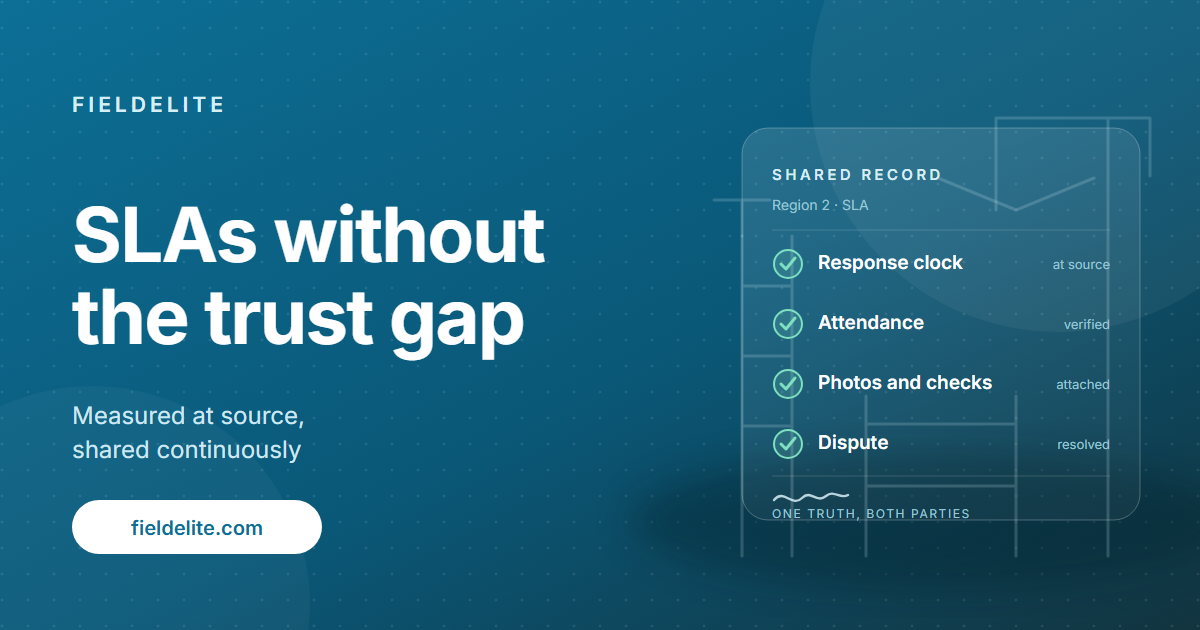
Many authorities and operators outsource station, depot and infrastructure maintenance under SLA regimes. Too many of those relationships run on what might be called the trust gap: performance disputes where the client and contractor each have invoices and impressions, but neither holds evidence either can accept.
The anatomy of a maintenance dispute
A performance regime has three failure points: measurement at source (the work wasn't recorded in a form either party trusts), definition drift (the SLA clock is measured differently by client and contractor — call-to-attendance versus call-to-completion being the classic), and consequence mismatch (penalties trigger against flawed measurement, so the relationship turns adversarial and the actual service suffers).
The trust gap is structural: the operational truth lives in the contractor's systems, presented at review meetings as summary reports the client can accept only on faith. Dispute follows dispute; the tender design is repeated with a new contractor and identical information asymmetry.
The shared-record pattern
There's an established resolution pattern that paradoxically improves service rather than punishing it:
- The job record — timestamps, photos, checks, asset condition — is system-of-record for both parties, not the contractor alone. One truth, visible continuously through client-facing views rather than summarised quarterly.
- SLA clocks are defined mechanically and measured at source, so "response time" is a system event sequence, not an argument.
- Asset condition and repair history accumulate into an engineering record shared by both parties — invaluable for the renewal business case, where asset base knowledge forms the repair-versus-replace debate at renewal.
- Disputes shrink to genuine commercial disagreements, resolved with genuine evidence, which is what the parties actually wanted.
The relationship outgrows the SLA in the best cases. When both parties work from the same continuous record, review meetings increasingly spend their time improving service rather than reconstructing history.
FieldElite runs the shared job record with client-facing views and SLA clocks measured at source. Talk to Denizon about evidence-based SLAs in one contract region.
Related: Contracts, SLA clocks and compliance evidence · Customer self-service · Contracts, SLA and certificates help · About FieldElite and Denizon

Nora writes about the operational and commercial questions behind service delivery: cost-to-serve, energy performance, footfall and transport planning.