Proving safety compliance, not just doing it
RAMS, briefings and checks that prove themselves: how construction sites turn safety activity into audit-ready evidence with FieldElite.
Every experienced safety officer knows the moment. The inspector's car pulls into the site, and someone asks the question that decides how the next few hours go:
"Can you show me the briefing record for the operatives working on the north-east scaffold today?"
If the answer is a folder, a WhatsApp thread, a stack of signed sheets in the site office, or "I'll ask Declan when he's back at half two", then the site might be safe. But the site cannot prove it is safe. And in compliance, unverifiable is indistinguishable from non-existent.
Doing safety and proving safety are different jobs
Most sites are doing the work. RAMS get written and approved. Toolbox talks happen at the compound most mornings. Operatives get inducted when they arrive. Vehicle checks get a glance before the gate.
The problem is that all of this activity produces evidence in a form nobody can assemble quickly, if at all:
- The RAMS was approved, but was the current revision briefed to the crew that started on Monday?
- The toolbox talk was given, but by whom, to whom, and is there a record with the date and attendance?
- The subcontractor signed the induction sheet three weeks ago, but his safe-pass and insurance expired last Friday. Who would notice, and when?
- The daily vehicle check was done. Probably. The sheet is in the cab, or was it last week's?
None of these are failures of intention. They are failures of format. Paper, spreadsheets and chat apps record safety activity in pieces that live in different places, on different devices, and only come together when someone is forced to reconstruct them, which is usually after something has gone wrong.
The two moments when format suddenly matters
For most of a project's life, the format of your safety records is invisible. It matters on exactly two occasions:
1. The inspection or audit. The HSA or HSE visit, the client audit, the principal contractor's monthly compliance return. These are evidence events. The question is never "is this site safe?" but "can you demonstrate it is?" A site that cannot produce briefing records, induction evidence and check histories within minutes treats the inspector to a toolkit of professional doubt.
2. The incident. This is worse, because the reconstruction is happening under stress while the clock is running. Which RAMS applied to that task? Was it briefed? Who signed the briefing? When did this subcontractor complete induction? When the answers take days to find, days of work stop while they're found, and the missing answers land on the desk of the person least able to defend them.
What good looks like: one record, connected to the job
The fix is not more paperwork. It is connecting the evidence to the job that produced it, so the record creates itself while the work happens.
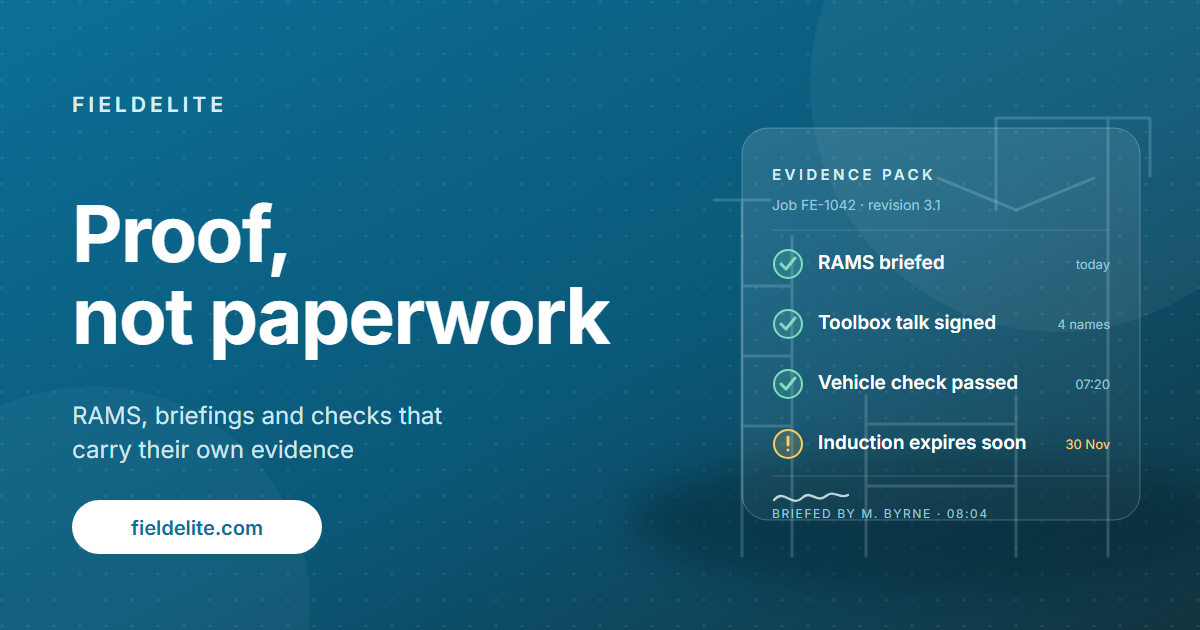
In practice, a job doesn't start until its safety layer is complete, because the system won't let it:
- The job references the RAMS. The operative's device shows the current revision of the method statement attached to the task they're about to do. Briefing it, and recording that they read it, is part of starting the job, not separate paperwork.
- A failed check stops the work. The daily vehicle or plant check is done on the phone. If it fails, the job stays blocked until someone with authority deals with it. That turns the check from a formality into a gate.
- Briefings and toolbox talks have attendance. The talk is recorded with who gave it, who attended, and the document version covered. Reconstruction takes thirty seconds, not three days.
- Compliance documents expire loudly. Safe-pass, insurance and subcontractor induction records carry expiry dates, and the system flags them before the person walks through the gate, not in the audit.
- The evidence pack is a download. When the inspector arrives, or the client asks, the whole trail for a job, a site, or a month is one export: tasks, briefings, checks, signatures, photos, dates.
This is what "one record from call to cash" means in practice for safety: the same job record that carries the photos and the signature also carries the proof that the work was set up safely before anyone lifted a tool.
The officer's benefit is quiet, and that's the point
The change in daily life isn't dramatic. It is the disappearance of the Sunday-night reconciliation, the missing-sheet panic, the "can you scan me that" emails. The safety officer stops being the site's archivist and goes back to being its engineer of safe behaviour, with leading indicators that finally trend because near-misses and observations are tapped onto the job in the moment, not rewritten into a spreadsheet on Friday.
And when the inspector's car does pull in, the answer to the question is: "Yes. Give me a minute and I'll print it."
Talk to us
FieldElite ties RAMS, briefings, daily checks and compliance documents to the job itself, so every task carries its own evidence trail. Start a 30-day free trial, or talk to our team about how your site proves safety today, and how it could.
Related: Multi-van fleet compliance case workflow · Contracts, SLA clocks and compliance evidence · Checklists, forms and evidence · Compare the plans

Niamh works on RAMS, SPA, vehicle checks and audit evidence for HVAC and cold-chain contractors. She reviews the safety templates with a competent-person mindset.