Your client wants monthly safety KPIs. Can you produce them without a spreadsheet marathon?
Client safety returns should be an export, not a monthly project. How job records produce toolbox talk, near-miss and corrective action KPIs on time.
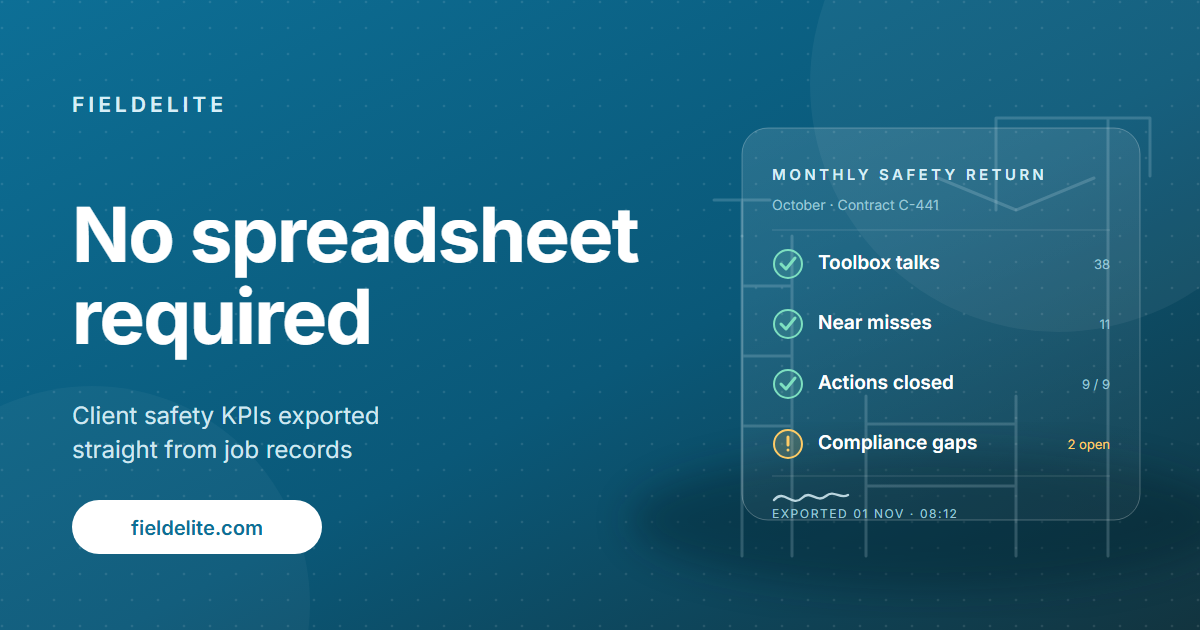
The request arrives in an email that looks routine: "As per the contract, please provide your monthly safety return, covering toolbox talk delivery, near-miss reporting, corrective actions closed out and compliance status of all on-site personnel, by the 5th."
For a well-run contractor, the honest reaction is dread, and the reason is structural. The activities listed all happen. The numbers about them live nowhere. So the monthly return becomes a project: texts to foremen, a hunt through WhatsApp groups, a spreadsheet built fresh each month, and figures whose main quality is that they were produced on time.
Why this gets more important, not less
Two trends converge. Tier-one clients and public frameworks are formalising supplier safety governance (pre-qualification questionnaires, post-award audits, ISO 45001 expectations flowing down the chain). And the contractors winning repeat work are the ones for whom the monthly return is an export, not an event.
There's a subtler cost too. Because the numbers get built under deadline, nobody uses them. The report goes to the client and is never read inward. Which near-miss categories are rising? Which sites never close corrective actions? What's the trend on briefing completion? Those questions would actually improve safety, but the data is too tired and too late to answer them.
What good looks like: the report that writes itself
The activities that constitute the KPIs, briefings delivered, near-misses recorded, actions opened and closed, compliance statuses, are all events in a system that already exists for running the jobs. A monthly return shouldn't require reassembling them; it should be a filtered view:
- Toolbox talks delivered, attendance, and which documents were covered.
- Near-misses and observations by category and site, recorded when they happen.
- Corrective actions with open/closed status and dates, not a column someone updates from memory.
- A compliance snapshot: who was on site, who had current certs, where the gaps were and what was done.
Then the interesting inversion happens: the report the client requested becomes the dashboard the contractor uses. Leading indicators get trended because the data finally supports trending. The monthly return stops being overhead and becomes management information.
The pitch to yourself
If your safety return takes longer to produce than the safety activities it describes took to perform, the process is inverted. Safety data should be a by-product of operations, not a parallel job.
FieldElite reports delivery and safety activity straight from job records, so the monthly client return is an export. Start a free trial and see next month's return write itself.
Related: Reports, map and billing review · Operations analytics and forecasts · Contracts, SLA clocks and compliance evidence · Compare the plans

Aoife looks after the finance and office workflows in FieldElite. She has a background in payroll and small-business accounting.