Feature
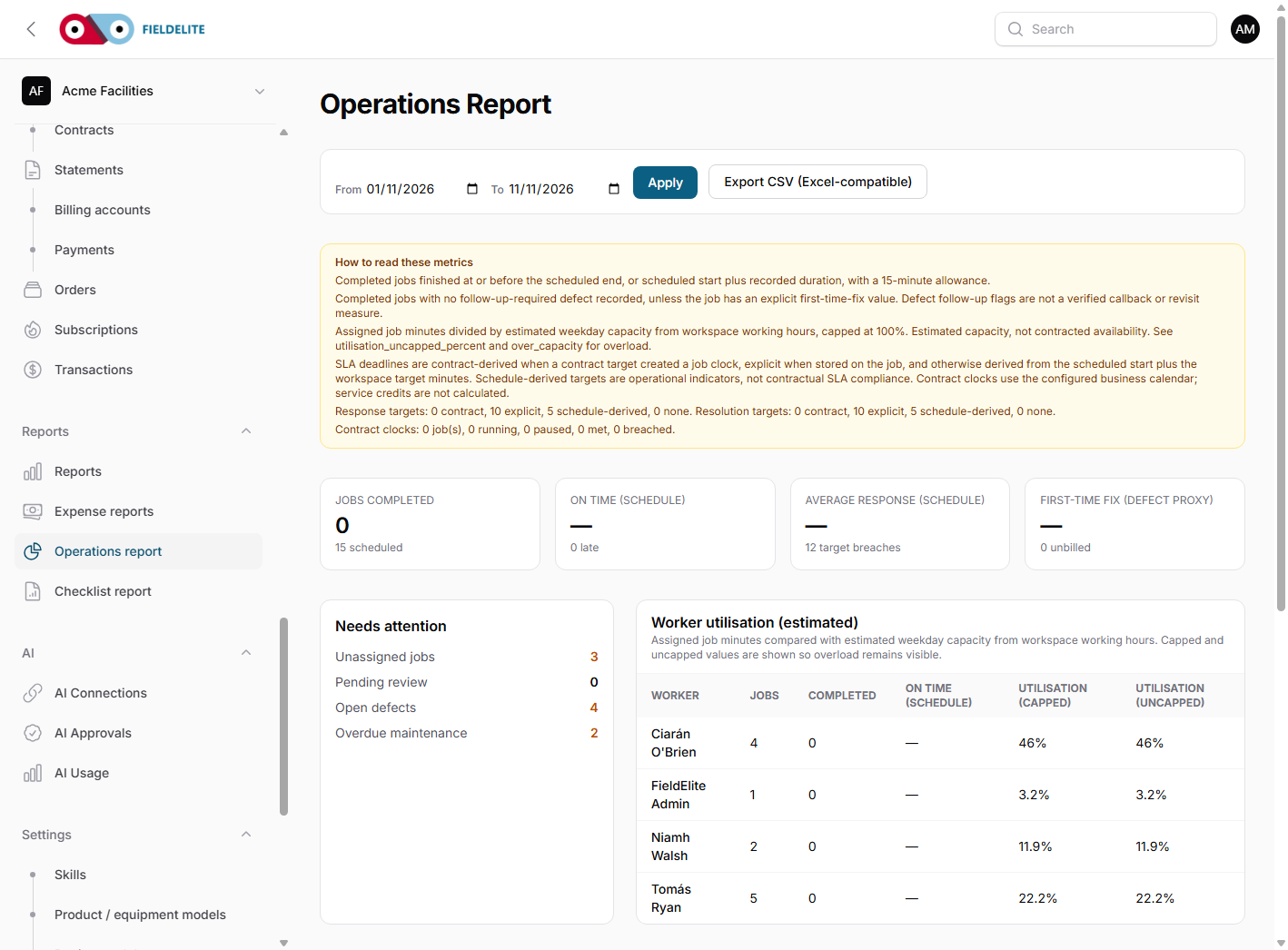
Plan with the numbers you have
Delivery, capacity, collections and parts demand without invented certainty.
The problem
A dashboard can look confident while the underlying data is missing. A blank travel distance, an uncosted hour or an invoice with no history should be visible, not silently treated as zero.
What you get
Delivery outcomes
On-time completion, response time, contractual SLA outcomes and PPM due/completed/late/missed/on-hold.
Time and travel
Recorded, billable and unbilled minutes, known travel miles and missing travel distances.
Repeat-visit proxy
A 14-day repeat-visit signal labelled as a proxy, not a causal guarantee.
Capacity and utilisation
Booked minutes against estimated capacity, with unavailable periods subtracted and overload visible.
Collection rate proxy
Historical cash collection by customer or global rate, applied to open balances by aging bucket.
Parts demand proxy
Trailing consumption projected four weeks against available stock and reorder levels.
How it works
Choose the period
Open the operations report and set the date range.
Read the outcomes
Start with SLA, PPM, time and data quality. Unknowns stay visible.
Review capacity
Compare booked minutes with current-availability capacity and inspect uncapped utilisation.
Plan cash and parts
Use the collection and parts proxies as prompts, with their limitations beside the numbers.
Questions about analytics
Is the collection figure a guarantee?
No. It applies a historical cash-allocation rate to open balances. Disputed and insolvent customers are not modelled.
Does the parts forecast create purchase orders?
No. It highlights projected shortfalls. Purchasing remains a human decision.
Why is a metric blank?
The report reports missing clocks, cost rates, travel distance or completion times as unknown instead of zero.
Does it use historical availability?
Utilisation subtracts recorded unavailable periods. Capacity still uses current availability and workspace working hours.
See the report with your own jobs
Bring a month of jobs, invoices and stock movements to a short walkthrough.
Book a walkthroughKeep reading
Help articles for this feature
From the blog
A job loses context every time it changes hands. Here is how one connected record covers the customer, the site, the engineer, the evidence and the invoice — with a walk through the FieldElite demo workspace.
Three buildings, one small team, and tenants who want proof. A practical look at planned maintenance, reactive dispatch and portal approvals using the Acme Facilities demo case study.
A sensor reading is not a response. Here is the chain from telemetry to an SLA clock, a certified engineer, a temperature record and a defensible invoice, using the Northwind Cold Chain demo case.