From CCTV to sensors: upgrading surveillance infrastructure into an information asset
Existing cameras already overlook the busiest spaces. How anonymous edge analytics turn a security estate into operational occupancy and flow data.
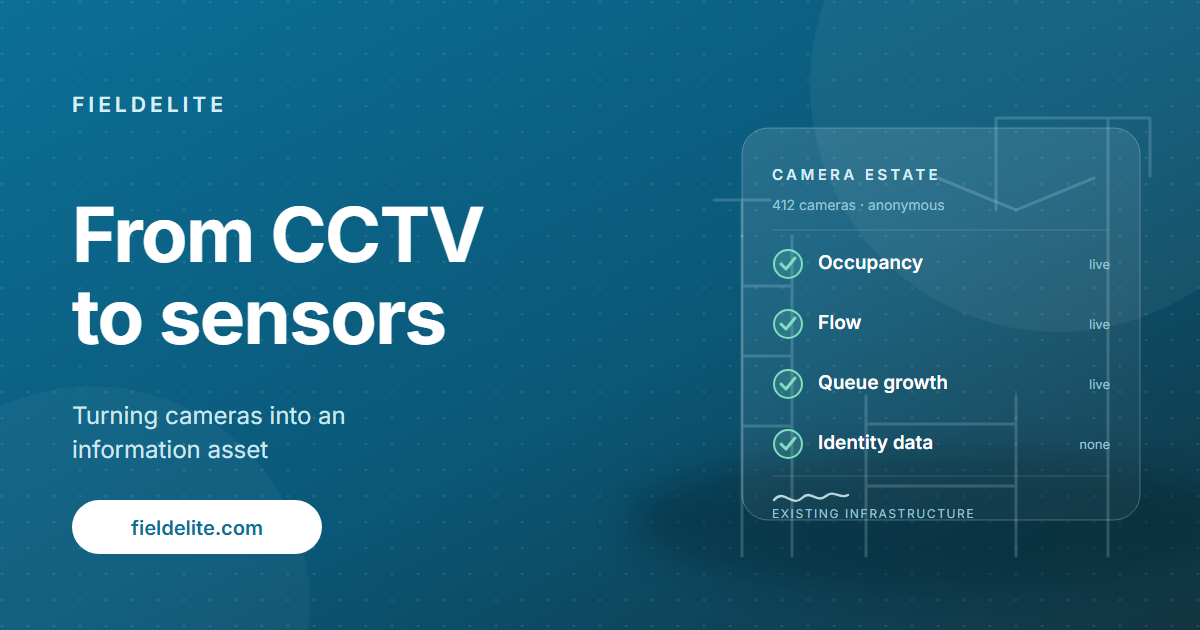
A mid-sized transport authority operates hundreds of cameras. They were procured for one purpose: security and incident review. They run continuously, generate continuous footage, and produce operational value at a tiny fraction of their running cost — because the footage is seen only when something has already gone wrong.
The question nobody asks the camera estate
The same infrastructure sits above the very places where operational data is most scarce: platforms, concourses, gates, interchanges, station retail, bicycle parking. What the cameras see continuously — occupancy, flow, crowding formation, queue growth, dwell patterns — is discarded rather than captured, because the analytic layer was never built.
Turning cameras into a dual-purpose estate
Modern on-device video analytics can convert the existing camera estate into a sensing layer without changing the surveillance function:
- Anonymous analysis at the edge: counts, flows and occupancy computed on or near the device, with no identifying data ever stored — the same design position we've argued for in people counting generally. The privacy officer's question gets the same answer: the system has nowhere to keep an identity.
- Occupancy and flow data to operations: live platform occupancy, concourse density, queue growth — flowed into operations reporting and crowd-safety alerting, alongside the CRS (security) retention regime the footage already follows.
- Data harmonised with other sensing: gate lines and counters measure part of the picture; camera-derived analytics fill the spaces between the gates, on one integrated timeline.
For authorities the commercial logic is strong: the marginal cost of sensorising an existing camera is a fraction of deploying a new sensing estate, so an authority's stalled analytics ambition converts into an infrastructure upgrade with an existing capital base already installed.
There's a realistic caveat worth stating openly: results depend on camera position and scene coverage, some locations will need supplemental sensing, and governance still needs explicit sign-off even in an anonymous architecture. Authorities that conduct this honestly — pilot first, publish the analytics purpose, keep security and operational data regimes separate — tend to obtain sign-off where others stall. (This connects directly to our "anonymous by design" article on the privacy meeting.)
Denizon converts existing surveillance estates into anonymous operational sensing layers. Talk to us about a camera-estate assessment.
Related: Operations analytics and forecasts · Reports, map and billing review · About FieldElite and Denizon · Contact the team

Nora writes about the operational and commercial questions behind service delivery: cost-to-serve, energy performance, footfall and transport planning.